Q: SC wrote,
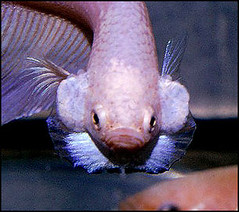
We have a betta who has been living happily in a community tank. About four weeks ago, he started to get a bit off colour and seemed to spend a lot of time resting on the pump. About ten days ago we noticed that he was holding one of his gill covers open and it looked as though there was a fungus infection. We put him in a quarantine tank and gave him a fungus treatment that seemed to get rid of the obvious fungus, but he still seemed listless and his gill cover was still open. In desperation we did a water change and started an anti-bacterial treatment. He perked up for a day or so and swam about more, but now has gone back to being listless and breathing at the surface.He isn’t eating either. There doesn’t seem to be any sign of parasites and none of our other fish are ill. Water quality is fine. The only other outward sign is that inside the affected gill there seem to be two white lines like the edges of a square – I wondered if this is hyperplasia. We are reluctant to try him on any other treatment without a better idea of what we are doing. Any help would be much appreciated.
A: Gill tissue is quite sensitive and susceptible to damage from toxins. Ammonia and nitrite, for instance, can reek havoc on fragile gill tissue even at seemingly low levels like .25 -.5 ppm. In basic water with a pH above 7.0 toxins become considerably more potent. It’s not uncommon for damaged gill tissue to form a stringy mucus similar to that of a bacterial disease like Flavobacterium columnare. It’s possible that this is what you were seeing instead of a fungus. Additionally, antibiotics tend to deplete the water of dissolved oxygen causing the Betta to hang out toward the surface for better air access.
Gill tissue doesn’t tend to heal very well and in some cases will grow a coating of new cells that causes the swelling and partially open operculum you are observing. This new tissue growth is what we call Hyperplasia. It’s essentially creating a scar that makes it harder for the Betta to get oxygen from the water.
Another thing to keep in mind is that toxins aren’t the only cause of gill swelling. This could easily occur from an injury, either from tank décor or other fish. You mentioned that your water quality was in good shape so it’s possible the cause was from physical irritation. Chlorine and chloramine exposure could also create a problem.
Severe Hyperplasia is generally irreversible but there are some steps you can take to help your Betta. First, keep the water clean and free from any toxins. Separate out any aggressive fish that may be taunting your Betta and remove or fix any sharp or jagged aquarium décor. Aquarium salt can be very useful for improving gill function and is frequently used to guard against nitrite poisoning. I recommend 1 TBL spoon per 5 gallons of water. Be sure to use aquarium salt and not table salt and add the salt to the change water instead of the tank directly. This will help you avoid an accumulation of salt over time since it doesn’t evaporate. Since your Betta may be relying on his labyrinth organ more then usual, he may be more comfortable near the surface. Make sure the water isn’t too deep and that he has places to rest near the surface. I’m fairly sure, though not 100% certain, that the labyrinth organ works independently from the gills, so he may have the advantage of having a secondary means of getting oxygen over other fish that would succumb from the gill damage. **See Follow-up
Good luck, and please let us know how he does.
**Follow-up
I contacted some other aquarists who believe the labyrinth organ works independently of the gills. Additionally, the gills are believed to be the weaker of the two means of getting oxygen and probably not as strong as in fish who rely entirely on their gills. It’s theorized that a betta who has sustained some damage to the gills may have a better chance for survival because it is their secondary mean of obtaining oxygen. There are a lot of variables but this could be hopeful news for this betta.
Leave a Reply