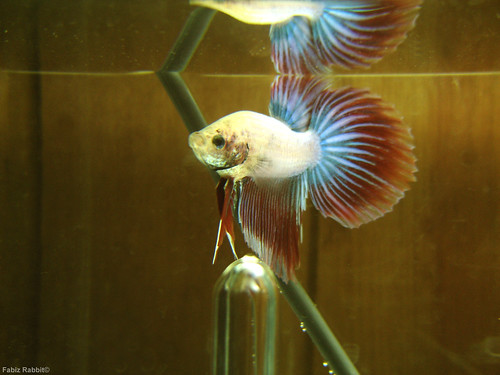
Q: CLP wrote,
I got my male betta – Will on November 5th, so he’s still young. He is in a 2 1/2 gallon tank, heated to 76 degrees. I do weekly water changes of 25% and the pH is at 7.0. My betta has started having fin rot. I went to a fish store, which said the aquarium salt would help him. I’ve been using the aquarium salt for about month, approximately when the fish rot started.
The fin rot, a small amount on one fin – had been going away over this time. He had been active the whole time and swam around a lot. Last Saturday afternoon 3/3, I did my regular water change of 25% of the tank- and added 1/2 teaspoon of salt into the entire aquarium, not the water I was adding. This was definitely my mistake. I do not know exactly how much salt was in the aquarium – but I think it had 2 teaspoons at least over the course of a month.
Later that afternoon he was moving around more slowly and at the evening he was laying at the bottom and breathing heavily. I did a water change – 25% of the tank and the next morning he was not moving much, and still mostly lay at the bottom of the tank. I changed the water again – this time 30%. He swam around a bit more and definitely there was improvement in the afternoon. Yet he still had trouble breathing and still stayed resting a decent amount of time. I put air bubbles on, which I only used in the past when I changed the water. It’s been on all week since Sunday 3/4.
I also put the filter on, which I only used in the past during a water change. This has also been on all week – since Sunday 3/4.
On Wednesday, I did a 25% water change and for a while he was resting at the bottom and then started to swim around more. The last several days, including today Saturday – he swims around when I feed him (1 pellet in the morning and afternoon – there is never any food left over in the tank – he does have a good appetite) and he swims around when I come over to his aquarium, yet he does rest a lot. He also is breathing heavily after swimming for 1-2 minutes and rests.
I wanted to know what long term affects and damage has the salt done to him? He swims more in a jagged path instead of a long flowing swim around the tank. He also used to blow lots of air bubbles and he has stopped, as he has trouble staying at the top of the aquarium for more than 30 seconds to a minute. Will he get back to normal if he continues to improve over the next few weeks, or has the salt done permanent damage to him? Also, is he in pain as I see him having trouble breathing and swimming in jagged path?
A: Thanks for writing in. This is an interesting question you have asked about the long-term effects of too much aquarium salt in a freshwater tank. I’m not entirely sure, as no studies, which I know of, have been done. I’d imagine it can put added stress on some of the internal organs and possibly cause some gill damage but am not sure of anything more specifically. I have, however, posed the question to some other aquarists and will follow up when I hear back.
I think the partial water changes you have done to rectify the situation were a good idea and I suggest continuing to do a couple more larger water changes to make sure most of the salt is gone. There was one additional thing I noticed in your email regarding your tank’s biological cycle, which could be adding to your betta’s stress.
You mentioned doing partial 25% water changes regularly and only running the filter during cleanings. When you do 25% water changes you are only removing 25% of the toxins like ammonia and nitrite. In a cycled tank these partial water changes are fine because you are growing beneficial bacteria in your filter media and gravel that will consume these toxins. If you don’t have the filter running, however, these bacterial colonies tend to die off and the toxins are able to build because there is nothing to consume them. It’s best to either cycle the tank and keep the filter on at all times, doing partial water changes or to remove the filter and do complete 100% water changes to avoid toxicity. You may want to test your water for ammonia, nitrite and nitrate to make sure their levels are safe. The presence of ammonia or nitrite also cause the gasping you described.
Also, you may want to consider feeding him a little more. Overfeeding can cause problems with bettas but 2 pellets a day is still quite sparse. You can at least double that, though if he isn’t looking thin he may be ok. It’s totally your call. I just wanted to mention it.
As soon as I find more information on the effects of salt poisoning, I will let you know. I’m really happy to hear that he’s doing better and I hope he continues to improve.
UPDATE:
I wasn’t able to find a lot of information on the effects of oversalting the water in a freshwater tank but can add that too much salt may lead to an overactive slime coat and in severe cases can lead to dehydration. Remember, through osmosis, a feshwater fish will loose water when placed in a tank with too much salt. Because the kidneys are responsible for maintaining the proper salt content in the blood, I suppose it’s possible that they could be effected by over salting, though I wasn’t able to confirm this. Hope this is helpful. If I find anymore info I will post additional followups.
hey, I’ve got three black mollies in a 10 gallon, I added two table spoons of aquarium salt into the tank and the water is now extremely cloudy and foggy. Is this normal? how long will it take to go away? what do I do?