I have a 20 gal long with some peaceful community fish and I’m currently keeping a male and female in separate tanks. I’d like to add them both to this one tank but don’t know how they will react in the same tank. Is it safe to house them together?
A: Generally speaking it isn’t a good idea to house male and female Betta splendens in the same aquarium. Both sexes are capable of serious aggression. Most commonly, males will harass females if perceived to be in their territory but I have also bared witness to a female killing a male brutally after crossing a tank divider. This is not to say it is impossible in a 20 gallon tank. In a tank that is this size or larger you may be able to have a pair of bettas set up separate territories provided the following:
1. Their individual personalities are relaxed or submissive. Individual Bettas, both males and females, have unique personalities. Some are highly territorial while others are more complacent. If you have had your bettas for some time and have come to understand they are gentler (well, as gentle as Fighting Fish can be) then you may consider housing them together.
2. The tank set-up should be conducive to housing both fish. A more horizontal tank, like your 20 gallon/long, is appropriate. There should be calmer, current-free water on either side making each far end inviting for the bettas. Try placing the HOB filter in the middle as an invisible barrier between the sides. Lots of hiding spots and heavy plant material will help to block sightlines from one Betta to the other. Less contact is better.
3. Provide ample time for observation. If you are a Monday-Friday worker, try acclimating them to their new tank on a Saturday morning and continue to monitor them carefully all weekend. Dropping them in and going to work could leave you with one or two dead bettas when you return. Also, have a Plan B. Plan B would include keeping their old tanks up and running in case you need to separate them again and having some antiseptic fish medication like BettaFix or Melafix on hand to apply to injured bettas.
Housing a male and female together could prove to be very interesting and you may even get to observe their courting behavior, however, their is significant risk for injury or even death. I would recommend exercising extreme caution and remember that an aquarium is not a truly natural environment. You are responsible for their wellbeing.
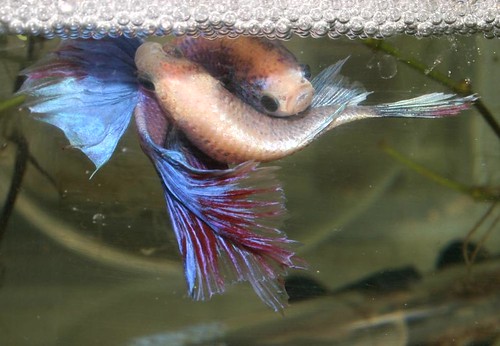
Male and Female Bettas, originally uploaded by sweet_nurse72.
Nice article! I am getting tempted to keep Bettas, as I am reading your blog!
THanks for sharing those invaluable info. Happy Betta keeping!
Thanks Samit,
They are great fish to keep and one of the most beautiful of the freshwater tropicals. Their availability and interesting behavior make them ideal aquarium fish. Let us know if you end up setting up a Betta tank.
Christie
hi, nice blog 🙂
i got my first betta today,
and he seems to be settling in really well.
he is bright blue with a navy coloured head and loves the corners of the tank. He seems to get on really well with the other fish and was not at all botherd by being pestered by my one remaining tetra 🙁 …. 🙂 it was intersting to read about housing both females and males but i think I will stick to just the one, they are beautiful enough on their own, thanx a lot, Georgia x
I tend to agree there Georgia. Keeping them together could be interesting but I don’t like to chance it personally.
NIce fish. 🙂 It looks like a hibrid fish to me haha not in a bad way. my betta lived in a tiny bowl for a couple weeks but then he seemed really crowded so now hes a 5 gallon tank. 🙂
I’ve had a pair together in my 42 gallon community tank for quite a while now. I found two that seemed quite docile, I also looked for a large male hoping he was too old to worry about breeding.
Seems to have worked extremely well. They actually swim around together adorably… Neither are territorial. They are both very happy and friendly–so much that they’ll swim up to my hand together and eat right from it.
THANKS FOR SHARING I HAVE A MALE AND FEMALE BETTA AND I DID’NT KNOW MUCH ABOUT THEM AT ALL SO READING UR BLOG HAS GAVE ME ALOT OF KNOWLAGE ABOUT IF I SHOULD PUT THEM TOGEATHER OR KEEP THEM SEPERATE .
As far as housing male and female betta together goes i know for a fact it can be done. In fact housing female betta together is a common practice provided a few hiding places for the less dominate to hide in are given. I house one of my old large red vail tail’s in my female tank and he just goes about his day swimming for the most part. The only times its a good idea to house two or more males together without a devider are when there newly hatched and when there verry old (out of breeding ages) to avoid alot of that aggression. and provide more than ample space for the loser of a skirmish to hide in and swim in without direct lines of sight between eachother. Ensure the tank is heavily planted to once again brake lines of sight between the males.But the safest bet is not to house two male in the same tank just jar them.
Now I have an tolerant/aggressive betta fish and a betta fish that is VERY laid back and easy going. They are both males. What is your opinion won housing them in a 2.5 gallon tank.
I actually started experimenting with the idea of housing males and females together when I first saw a pind with male and female plakats on the net, then again I saw a local store pull it off…about seven females and four males in a tank with some guppies / platies. I then tried this myself, and was able to keep two males at peace in a tank with three females together. I was not sure if it was a fluke or not. That got very different when I added a third male in a separate compartment in the same aquarium; immediately had to split all the males up once the flaring looked too aggressive. Will look more into it though but based on my findings, it is possible once certain tfactors are considered.
Hi, I have problem with my male, He doesn’t make a bub nest =(
please give me some tips how to help my male t make bub nest so I can start my first breeding.
My male and 2 female bettas had to be put into my 30 gallon community tank during an emergency. The male will get his share of fin nipping as he ambushes the fins of my fin nipping tiger barbs. Fin nippers will nip at a betta if the school of fin nippers aren’t big enough. Male bettas will sneak up on a fish and bite their tail if they are in his way. The male will chase the female randomly if she gets to close. You really have to watch and see how your bettas
react towards other fish in a community tank. If they’re getting bullied by the fin nippers to much, the Bettas will get too stressed and die. The strong current from a power filter will stressed them to death also. I recommend placing a large artificial leaf (that will float) under the output of the power filter, with the stem of the leaf placed into a suction cup and stick it to the wall of the tank. That will carry the water current across the surface of the water instead of tumbling into the depths of the tank where bettas will be swimming. You will also see that the bettas enjoy hanging out under the large leaf eating snail eggs or hiding out, because there is no water current under there, just rapid water flow across the leaf. The male won’t make a nest around a lot of fish (too many fish to fight off is stressful to the fish) or when there’s a strong water
current! (The nest would just blow away)
This was my experience in that situation!
The Betta is a fighter but their long fins gives them a weakness especially amongst fin nippers!
I have 2 female Betta in a 5 gallon tank they are thriving and happy I want to begin breeding how do I begin this process (obviously by a male but after that??)???