For the first of the fish series, I have decided to write about the most talked about fish in my aquarium… the Cryptocentrus cinctus, otherwise known as the Yellow Watchman Goby. The Cryptocenntrus cinctus also goes by the common names of Yellow Shrimp/Prawn Goby, Midas Goby, Watchman Gold and Yellow Spotted Blenny.
Gobies are the largest family of fish found in the ocean, and they include dartfish, jawfish and blennies. Most gobies have a fused ventral fin, which they will use to perch or suction themselves onto glass or rockwork with. The watchman goby is yellow and has a tall dorsal fin with blue spots along its’ head, body and fins. My watchman’s face looks so grumpy and serious, but there are other times that he almost seems to be smiling! A watchman goby’s eyes are rather large and placed high upon his head, and perhaps this is what makes him such a good “watchman”. A watchman goby grows up to about 3 inches (7 cm) in length and requires a pH of 8.1-8.4, sg of 1.020-1.025 and temperature of 74-80ºF (23-27ºC). This goby is considered to be very easy to care for.
Gobies are usually a peaceful fish, but they do not get along well with others from their own species unless they are a mated pair. In the ocean, gobies are usually found in the sandy spots of the reef, and many of the goby family are known for their burrowing behavior. The goby, as a territorial fish, requires a lot of rockwork to hide in and sandy places to burrow into. Like most other fish, the more places that they have to hide in, the safer that they will feel, in order to come out into the open. They are bottom-dwellers, who play an important role in maintaining live sand by keeping it aerated via their burrowing activites.
Gobies are known to have a symbiotic relationship with pistol shrimp. Both the shrimp and goby will occupy the same burrow. The watchman is particularly suited to guard the entrance because of its’ large, high-set eyes, while the shrimp with its’ small, recessed eyes, is good at digging out the burrow and maintaining it. The two communicate by touch. The shrimp will touch the watchman’s tail with one or both of its’ antennae, and if it feels “rapid tail flicking”, the two will quickly disappear into their burrow, away from immediate danger!
My goby, named Gobes, is almost always the first to the front of the tank come feeding time! A goby’s diet should consist of meaty foods such as mysis shrimp, black worms, pods, or zoo-plankton (small crustaceans and fish larvae). Pods are very small invertebrates that will naturally reproduce in the aquarium. Pods live in the rocks and in the sand bed, and often become food if they leave either. A goby, though, will pretty much eat anything that it can fit in its’ mouth. Often, you will see a goby take in a mouthful of sand, then expel the sand through slits in its’ gills, hopefully rewarding himself with a tender morsel of something! Although it is indicated to feed them twice a day, I have found that if you have an ample pod population, you may be able to reduce the amount of feedings to once per day. Besides, watching a goby hop around the tank, hunting pods, is very fun to watch!
Although the watchman goby is best housed in an aquarium sized 30 gallons or larger, I have had experience keeping a 1.5 inch watchman, a same-sized pistol shrimp and a thimble-sized hermit crab (Larry, Curly and Moe, respectively ) in a 5 gallon and it was very comical to watch! Larry, the watchman, and Curly, the pistol shrimp, would take turns with one watching over their burrowed home and the other, foraging for food. They acted like birds bringing food back to the nest. Moe, a blue legged hermit crab, was just a trip in his own right. Most hermit crabs are fun to watch scamper around. Moe always seem stunned to run into the Larry, and had that look of surprise, and then he would follow Larry around like a puppy dog, hoping for scraps from the table! I eventually sold this setup to another aquariust who tells me that Larry, Curly and Moe are doing fine to this day. It should be noted though that keeping water parameters stable in such a small saltwater tank takes experience and a lot of work with frequent water parameter testing, feedings and water changes. A 30 gallon or larger tank would be recommended for the beginning saltwater keeper and never such a small one as a 5-gallon.
Be aware that the watchman has been known to jump, so be sure that its’ aquarium has a well-fitting lid.
The watchman goby has been bred in capitivity. Hobbyists are hopeful that tank-bred watchmans will be more healthy and hardy than their wild-caught counterparts.
Here is my watchmen goby, Gobes, peaking out of his burrow…
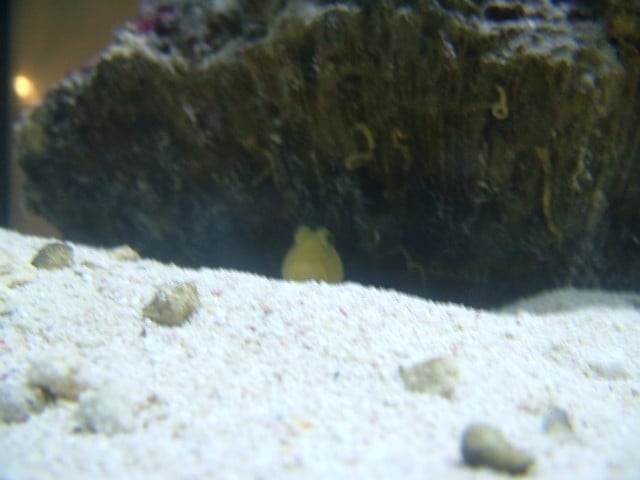
Here is Gobes starting out his day, hunting for pods…
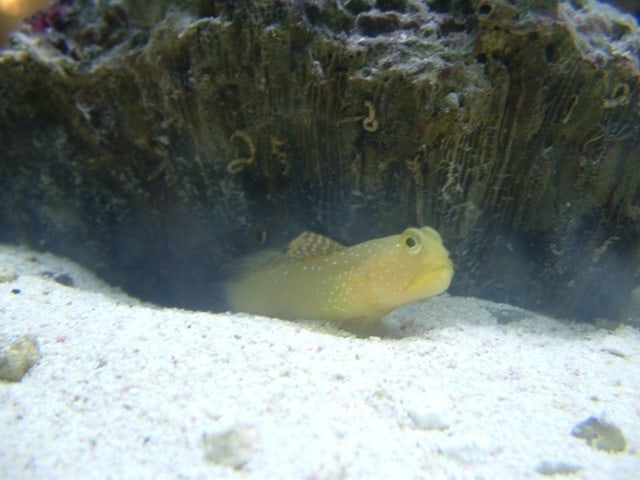
Yes, hunting is very serious business indeed! 🙂
Now, how could you not want a face like this in your tank to love?! 🙂
Leave a Reply