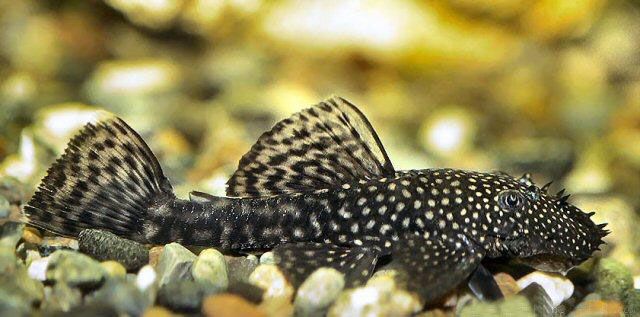
It’s funny really, but when we start keeping tropical fish we tend to finish up with certain favorites that we like to keep and breed, and for me one of those favourites is the Bristlenose Catfish (Ancistrus sp.), which I have been breeding for quite some time now.
We often give our fish names, but I just call my main pair “Mum ‘n’ Dad”, and they first spawned for me around three and a half years ago when they were only 4cm long. Mum ‘n’ Dad are now four years old, and are about 10cm long, but still go at the spawning as if they were still youngsters. There is still one survivor from this first spawning that I know of, and she is doing really well in my friends’ tank. They named her Tippy.
It’s pretty easy to spot the “Dads” from the “Mums”, as the males develop a wonderful set of bushy bristles around their top lip which extends up the middle of their face, while the females seem to occasionally grow shorter bristles around their top lip, but never down the middle of the face like the males.
There are few fish that you will find that will cope with algae like the Bristlenose Catfish, and I am pleased to say that I have “never” had an algae problem with these guys around. I recently came across a nine year old fishkeeper who had a tank covered in the stuff and looked revoltingly green, but after popping a couple of these fellas in, the tank was spotless within two days.
Hey…. These guys are “Cheap to Keep” as well, and for unpaid workers they do a great job of getting every bit of algae in sight, but they also like a feed of fresh, steamed vegetables, such as peas (peel them first), zucchini, pumpkin, and beans. I feed mine mainly steamed peas and algae pellets, but they LOVE an occasional feed of bloodworms too. Feed only small amounts, and make sure you clean the leftovers up. Driftwood helps with digestion, but more on that later.
Bristlenoses get along with pretty much everything – as long as THEY don’t get eaten!! They are great for any type of tank.
If you are wanting to spawn these fish, then some form of cave seems vital to getting a successful spawn, as they need a domain that they can call their own. I find that a small entrance with a large inside works best for me, as it will give “Dad” a cave of sorts that he can “protect and defend” from other fish that may get too close, and also give him some moving room inside where he can tend to the family needs. Give them some caves!! Vital.
My “cave” is an ornamental castle that I bought some years ago at the Local Tropical Fish Shop (LFS). This has become a main feature in my tank, and I really love what has become known as “Catfish Castle”. It’s pretty hard to actually see the eggs in there, and I have only actually seen them once, but although a lot of people feel the need to be able to see the eggs, I always reckon that if I can’t see them, then Dad is doing a real good job, and must be relaxed!!!
The entrance to “Catfish Castle” is only 2cm wide x 2cm tall with tiny windows (.5cm x 1cm) and all the new babies come out the windows, which is really cute to watch, but there is plenty of room inside for Dad to turn around and move etc. You don’t of course need a “Castle” like mine, as many things will make a suitable cave, like an old ceramic flower pot (even a broken one as long as no fish can cut themselves). A friend of mine uses a mug, yep, an old coffee mug with a larger rock over it. There’s heaps of ideas!! You are only limited by your imagination – but be aware of what your cave is made of; e.g. a plaster ornament will disintegrate and your fish won’t be very happy with you!! You can make caves just by arranging your driftwood and rocks. I have a few different things in my tank, and “Mum ‘n’ Dad” each have their own things that they like to stick to, like Dad has his “Catfish Castle” where he tends to the eggs and family, while Mum occupies another older Castle up the back. I also have a half ceramic pot over the entrance, which I call the “Rock Cave”, and it’s what Dad uses when he’s not looking after the eggs, and Mum sometimes uses it if Dad is busy tending the eggs or young. I also have a fake hollow log, and a few other half ceramic pots, which all make good hiding and resting places. There is also a fake hollow log and other ceramic half pots too!!
Bristlenoses like to breed in caves!!!!! The male will pick out HIS cave for permanent residence. When the female is ready to spawn she will chase him out of his cave. (Looks a bit like a “love-dance”). This is the only time I’ve ever seen “Mum” dominate “Dad.” Mum will then spawn her eggs in Dad’s cave! Then Dad does ALL the work. From now on, the male will be a busy boy, and he will keep water flowing over the eggs, to prevent them from going to fungus. He does this apparently by feeling the water flow with his bristles!! Dad also chases away all and any other fish that come too close. But he only chases, he doesn’t attack.
Once the eggs are laid it takes 5-6 days for them to hatch, then it takes another 5-6 days for the babies to eat their egg sacs. They then become free swimming and independent. They are about 1cm when free-swimming and can take them up to 4 or 5 months to grow to 3cm (selling size).
If you are thinking of breeding these wonderful workaholics of the aquarium, then make sure you have plenty of tank space prepared for them, as once they start spawning they just will not stop.
It seems that Bristlenose Cats need some sort of driftwood to “munch” on, and the reasons for this I am not quite sure as opinions vary, but it does appear that they need fibre in their diet. I have noticed that there are “always” baby bristlenoses on the driftwood, so this is the first place I look if I need to catch some. I just place a small piece of driftwood in a container to act as a “bait,” then as it becomes filled with fry I gently lift the container out, with no stress to the young. Mum ’n’ Dad are on the driftwood at least once a week, and seem to have a great time munching away at it.
Another thing I have noticed is that their colour changes depending on the situation, like when they are in the dark, they tend to get lighter. The male is usually harder to find, as he gets much lighter and his spots go sort of “blotchy,” while the female is a glorious deep dark brown. Dad does go dark also once he’s been out and about for a while. I always think of it as though they have just “gotten a tan,” but it is definitely mood related, and perhaps it could be some indication of spawning.
My Water Parameters for spawning these guys are as follows:
- Temp 26C,
- GH 100ppm,
- KH 70ppm
- pH 7.0
- Ammonia 0
- Nitrite 0
- Nitrate 0
Well peoples, that is just about it, and I hope that this little piece of mine will inspire others to give these wonderful fish a go, and also perhaps to encourage others to share their fishy experiences with the rest of the world, for what some of us find easy can be a great struggle for others, and sharing our knowledge is something we should all try to do.
Leave a Reply