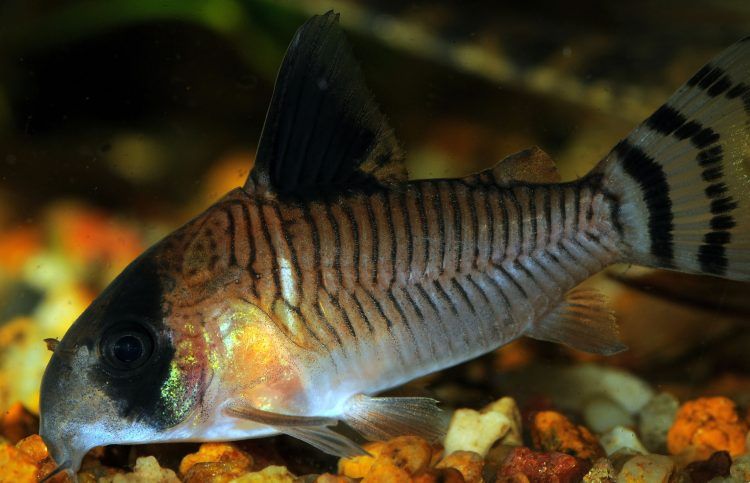
This small Corydoras is named for the river it is native to, the Oyapock in French Guiana. Unfortunately, it’s not a common find in pet shops, but may be more so in the future if more hobbyists take the time to breed them.
Corydoras oiapoquensis is very similar in size and coloration to Corydoras panda, but lacks the caudal peduncle spot, and makes up for it with a series of wavy stripes on the tail.
I was lucky enough to acquire some of these little catfish from a private breeder at a national fish show. I knew very little about them, as I’d never seem them before, save in books, so I bought his last five. They were about 3/4″ long, and seemed very healthy.
Soon after they got into their new home, a 20-gallon long, they started to spawn. I tried various methods of raising the fry, all with some success, but none with great success. I won’t go into the failures, which were many, but I’ll explain the two most successful.
The first method that I had luck with was removing the eggs to a separate hatching tank. I set up a 3-gallon tank with water from the breeding tank (well water of medium hardness, pH of 7.4, and room temperature of 70-75. I’d scrape the eggs off the glass with a razor blade (or a finger works as well) and put them into the smaller tank to hatch. The eggs that were in the gravel would come out when the gravel was washed at water changes, and the eggs in the plants had to be taken out by hand (this is a tedious job, but if you have kids, get them involved; they seem to enjoy it!)
I had the most luck with this method using a lot of current in the hatching tank. I used an air-driven sponge filter at one end, along with an outside filter and a power head attached to another sponge at the other, with the aeration turned to full. The end result looked like something like a brine shrimp hatchery turned on its side. With any less water movement, most of the young would die soon after hatching. Even with all the filtration and water changes twice a day, many of the fry were lost.
The final method that I tried, and the one that I still use, is the “less is more” approach that seems to work for me in more cases than not. It seems that if I can fight the urge to meddle in the lives of the fish, they reward me with more young than if I’m constantly “helping”.
I leave the parents, young fish, fry, and eggs in the same 20-gallon tank with the same water described above. There is standard aquarium gravel at 2″ depth, many larger stones for the smaller fish to hide under, and some bog wood with Java Moss attached. The fish are kept very well fed, and 30% water changes are done twice weekly. The temperature in the tank ranges from 70 degrees to 78, and spawning usually takes place at the lower temperatures, most often after a water change.
The adult fish eat a variety of live, frozen, and dry foods, and the young get microworms and baby brine shrimp. All are fed twice daily.
At any time, one may look into the tank and find breeding-sized adults, juvenile fish, newly hatched fry, and eggs. As long as the adults are kept well fed, they don’t seem to bother the eggs or fry.
I hope this report has encouraged other hobbyists to keep this little catfish. I’m sure anyone who does will find it worth the effort.
Leave a Reply