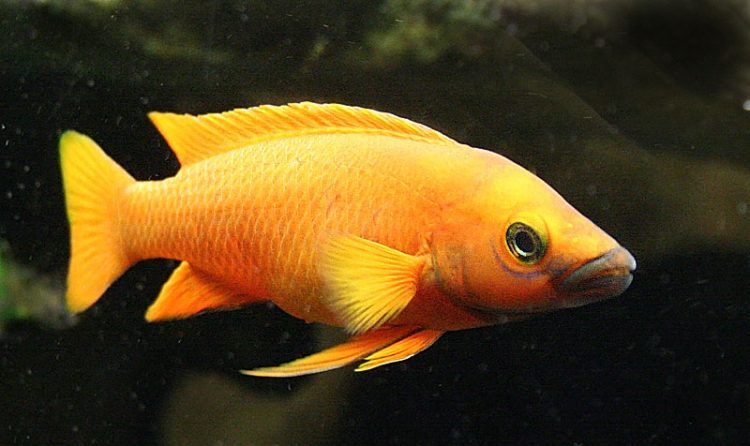
I have always admired this fish but had not had any success in keeping it in my tanks. I found myself in a local pet shop looking at the most brilliant yellow leleupi I had seen in many years. The store clerk must have picked up on my interest, maybe I had lingered too long, and joined me to watch these young fish swim around the tank. After a short discussion I was the owner of four, one-inch long leleupi.
Their new home was a 66-gallon aquarium. The dimensions are 60″ in length, 16″ in height and 16″ in depth. The aquarium was home to eight cherry barbs, a dozen Cryptocoryne wendtii, one Aponogeton madagascariensis and a canoeful of Java moss. At each end of the tank there was a large pile of lava rock. Three inches of natural gravel covered the bottom and into the gravel was stuck two cedar logs with holes drilled into them.
The leleupi disappeared into the rockwork and for many months I would only catch a glimpse of them at feeding time. I did notice that they never lost the brilliant yellow colour that they had in the store. They grew slowly but eventually reached a size of 2″. It was at this time that two of the fish seemed to take over one of the cedar logs. I noticed that there was only one other leleupi in the tank. I guessed that the fourth had succumbed to disease or bullying. I never found a trace of it. Being that the tank was five feet long, it gave the pair quite a large territory to defend, and defend it they did. The single fish was not allowed in the four feet that the pair had claimed and I am sure that if it was not for the rock pile at that end of the tank, I would have had to remove the fish to prevent its untimely death. The pair continued to excavate around the rockwork and the log and within a week I saw eggs inside the log. The eggs hatched and there were fry swimming around the opening of the log. As soon as they appeared, they disappeared. I hoped that the parents had moved them into the rockwork. It wasnt long before I saw fry swimming in and around the rocks. I counted over twenty fry but was sure that there were more that I could not see.
At this time the large male was now almost three and a half inches. He was now excavating with the other leleupi at the other end of the aquarium. I found this strange as I always thought that this fish formed strong pairs.
Approximately two weeks later the first female disappeared from sight. I hoped that she had laid eggs and was guarding them but she never was seen again.
Most species in the genus Neolamprologus are found only in Lake Tanganyika but some can be found in neighbouring rivers. They are found in shallow waters above a rocky bed. They feed on prawns, small shrimps and insects. In my aquarium, they were fed mainly frozen bloodworm and flake food. When the fish is in good condition the whole body is yellow or orange-yellow. Except for the white ventral fins, all the fins are the same colour as the body. When the fish is stressed or not in good condition it appears as a plain rust brown.
There are no external sexual differences and the only suggestion I have is that the males grow to an adult size of 8 centimetres + and the females reach an adult size of approximately 7 centimetres. In other words to have a better chance at getting a pair, buy four or more juvenile fish and allow them to pair off naturally.
The fish spawn in cavities and the eggs and fry are primarily cared for by the female. The parents do not continue to tend to the fry however the territory in which the fry stay is guarded intensively by the parents. Usually no more than 50 eggs are laid at a time however subsequent spawns are tolerated and you can witness many generations of fry swimming about together.
Leave a Reply