The first egglayer I ever spawned was Betta splendens. I did this in a five gallon metal framed aquarium with no heater. Now those of you who know anything about how Bettas love warm water for spawning are going to be a bit skeptical about this statement, but I kept the water warm by keeping the incandescent light in the metal hood lit continuously. I don’t know how those fish coped with no night time, but they did. Keeping the tank lit all the time had a side benefit. I wound up having a small culture of infusoria going in the tank, which provided a good source of food for the fry (the fry are raised in the same tank as they were spawned in). These days, I try to use a little more sophisticated methods to accomplish the same result.
The starting point for accomplishing this result is that I use floating water sprite (Ceratopteris thalictroides) as the support material for the bubble nest. Dwarf Gouramis particularly appreciate this plant as a nest site. The water sprite usually comes from a well established aquarium and I can’t confirm it as a scientific fact, but there seems to be an association of micro-organisms with the water sprite. These days I use fluorescent lighting, but I make sure that I have good intensity so that the water sprite, as well as algae, gets a good start in the spawning tank. As the breeders are being conditioned in the same tank, there may be left over food. A very small amount will also help the in-tank culture, but too much can spoil the tank. If the tank is not greening up with algae, I might also use a little trick that I learned from raising fry. I might put a very small amount of egg infusion into the tank.
Egg infusion is another time honored method of feeding very small fry. It used to be very common in stores, being sold under the name Liqui-fry as a first food for fry. I don’t see that stuff around much anymore, but that’s OK because it’s real easy to make for your self. All you do is hard boil an ordinary chicken egg. Once it has cooled, you remove the shell and the white (you can eat the white if you like) leaving just the yolk. Put the yolk into a sealable container along with a volume of water about equal to that of the egg yolk. You may want to mash up the yolk with a fork a little bit before the next step which is to seal the container and shake it for all you’re worth. Others may want to use a blender or a food processor, but either way you get a suspension of very fine particles of egg yolk. As mentioned above, this can be used to help along the infusoria culture in the spawning tank, but it can also be used to feed the fry.
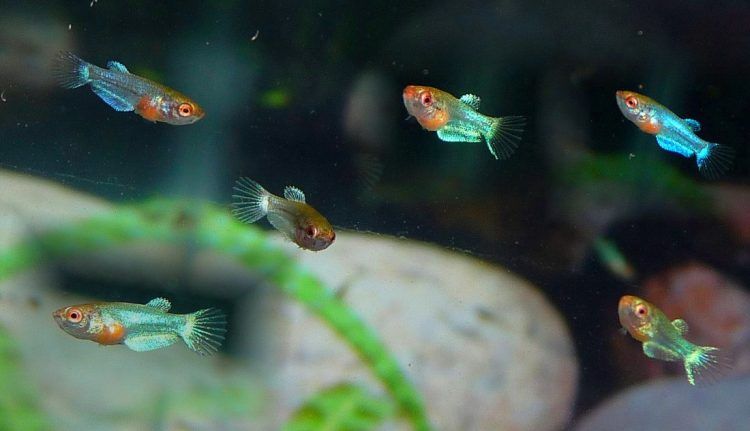
You can tell if fry have been eating what you have been feeding them by examining their stomachs. I used to be able to see anabantoid fry clearly with only my prescription glasses, but these days I need a good magnifying glass. Fry that have been eating egg yolk will have yellow stomachs while those that have been eating infusoria will have green to grey stomachs. Those stomachs will also have a noticeable bulge. With my system it just depends on how well my spawning tank infusoria is doing. They may not be fed any egg at all, or quite a bit. One of the biggest mistakes that can be made is to stay on very small food for too long. I try to get them to eat freshly hatched brine shrimp as soon as possible. Once they are eating brine shrimp, they’ll start growing more quickly and the worst of it is behind you, in fact you just may be able to get them to take very finely ground flake food very soon after they start taking brine shrimp.
One thing that seems to crop up in just about everything I’ve ever seen written about raising anabantoid fry is that their labyrinth organ develops after a few weeks and when they take their first breaths they should be warm and moist ones. In order to accomplish this they recommend that your tank be tightly covered. I don’t know about you, but my tanks just have a hood or a glass top on them. I don’t know how to make one any tighter than the other. Back when I used constant incandescent light to heat the tank, I know the first breath was warm and moist due to the condensation on the sides. Since then I have had spawnings where I know that the first breath was not particularly warm and not particularly moist, but I didn’t notice any difference in survival rate. It may be possible that the warm water surface may maintain a very thin layer of warm humid air which the fry draw upon, but whatever the actual conditions, I don’t worry too much about the first breaths of the fry.
One other consideration as far as Betta fry are concerned. You may be advised to separate out the males as soon as they are recognizable. I tend to not be in a big hurry to separate them. It’s a lot easier to raise them in a tank than in jars. They are usually not quite so aggressive toward fish that they have grown up with if they haven’t been separated so you can safely keep them together longer than you might otherwise think. Of course, if they start damaging fins, you’ve left them together for too long.
Another thing to keep in mind is that the spawns of the most common anabantoids are very large and you probably won’t be able to raise the entire spawn anyway. Don’t be discouraged if you only get a few salable fry from a single spawning that may have started out with hundreds, perhaps even a thousand, eggs.
So to sum up, I raise anabantoid fry by trying to culture a little infusoria in the spawning tank. I feed egg infusion if necessary. I start feeding freshly hatched brine shrimp as soon as they will take it and hopefully supplement that with finely ground flake food. I don’t worry about their first breath and I don’t worry about separating male Bettas until they start showing signs of aggression that may lead to fin damage.
Leave a Reply