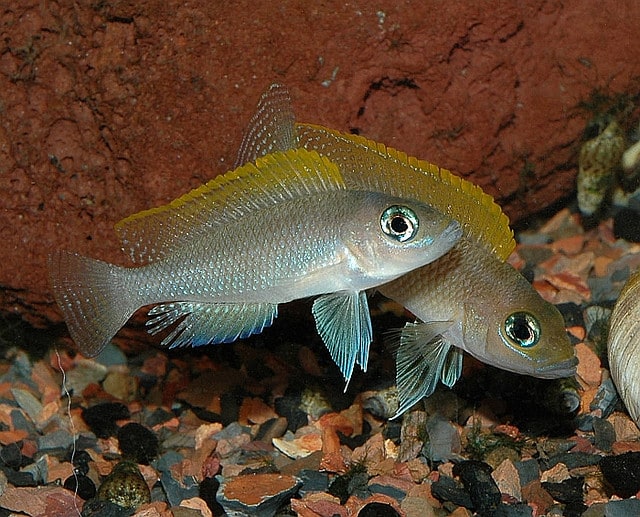
This is another species of Lake Tanganyikan cichlid that I have been working with recently. As you can tell by the name this is a species of fish that has yet to be officially named. Although it does resemble Neolamprologus quite a bit, it is currently classified as a separate species. In Ad Konings ‘Back to Nature Guide to Tanganyika Cichlids’, the author gives this fish separate mention amongst the Neolamprologines he did include in the book. This species of fish is found along the eastern coast of Lake Tanganyika between Fulwe Rocks and Kipili (hence the current name), inhabiting the shallow rocky and intermediate biotopes.
This species of fish certainly resembles Neolamprologus caudopunctatus in terms of body shape and base coloration. The visual difference is that Neolamprologus caudopunctatus has more yellow or orange coloration in the dorsal fin and the upper body while Neolamprologus sp. ‘caudopunctatus kipili’ lacks the yellow/orange and is characterized by white coloration in the fins, especially the tip of the pectoral fins. Other differences between the two species of fish include the fact that Neolamprologus caudopunctatus can attain a slightly larger size and forms large breeding groups, while Neolamprologus sp. ‘caudopunctatus kipili’ does not. Both species of fish are cave spawners.
I acquired two wild pairs of Neolamprologus sp. ‘caudopunctatus kipili’ at the end of last year. At the time I was only able to house the pairs in the same 30-gallon aquarium. Before long it was necessary to remove the weaker of the two males. After removing the weaker battered male to another tank, he hung on for a few days before succumbing to his injuries. The remaining trio did fine in the tank for a few months. At one point, for a reason still unknown to me, I lost one of the two females. Was not as a result of aggression as best I could tell. The loss of the one female seemingly went unnoticed by the remaining pair.
Knowing that the species is a cave brooder, I placed a few different types of spawning locations into the tank for the pair to choose from. The first was a clay spawning cave. The second was about a half dozen large sized shells, those typically used to spawn Altolamprologus. And the third was ‘artificial’ caves made up of small PVC elbows and end caps. I simply placed an end cap on the end of each elbow and placed them into the tank. About 8 – 10 of these PVC caves were placed into the tank. It was quickly apparent that the pair favored these PVC contraptions. In fact I ended up removing the shells and clay cave to use with other fish in other tanks. The female took up residence in one of the PVC caves that was located in the rear right of the tank. The male never claimed a PVC pipe, instead choosing to hang out under the sponge filter that was only a few inches away from the female’s PVC lair.
The tank itself contained a pair of sponge filters and about an inch of medium sized gravel. I used the gravel to bury the end of the PVC elbows that were capped, leaving the open end of the PVC elbow about ź” above the substrate. The tank was maintained with a temperature between 78 – 80 degrees Fahrenheit, a pH of about 8.0, and hardness level of 125 ppm KH. Water changes were made roughly once a week with 25 -30% of the water being replaced. A steady and mixed diet of frozen bloodworms, frozen brine shrimp, and flake food was provided. An occasional helping of freeze-dried krill was also offered. Under these environmental and dietary conditions, my pair did very well.
Not long after I lost the second female, I noticed that the female looked a little ‘lighter’, like she had not eaten in a few days. She was also spending much more time down in her chosen PVC cave. A couple days after noticing this, I also noticed that the pair had excavated a shallow pit in the gravel on the right hand side of the tank. The pit was not very deep, just deep enough to allow me to notice that they had done some redecorating. And then a couple days after the pit was dug, a cloud of fry could be noticed in the pit. The fry were offered a diet of baby brine shrimp and white worms, which they accepted greedily.
The pair is now spawning regularly, but the first couple spawns did not yield very good results. Only one fry made it out of the first spawn and only two on the second spawn. I now am about 3 – 4 weeks past the third spawn and there I still at least four dozen young from the spawn. I never noticed the parents eating the young on the first two spawns, but the easy and obvious assumption is that they did. The three young from the first two spawns are still in the thirty-gallon tank with the adult pair on the young fry from the third spawn. No issues to date with this arrangement. The young vary from about ž” (first spawn) to ź” (third spawn) and everyone is doing fine. Knowing that this species does not form breeding groups like Neolamprologus caudopunctatus, I am watchful of the older fry. My assumption is that the parents are tolerating them now but will treat them differently as they reach breeding size. I am sure I will need to remove them in the future. All-in-all this is a very interesting fish that I would recommend to anyone.
Leave a Reply