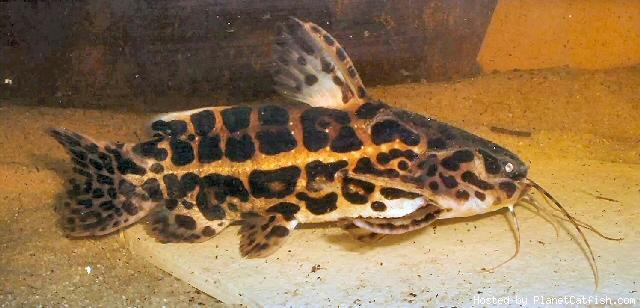
Named for the rare Jaguar Cat, Panthera onca, of the South American Rain forests and just as elusive and beautiful, Liosomodoras oncinus is a rarely seen catfish from Peru. Easily one of the most beautiful of all catfish, it has appeared, although infrequently, as a contaminant in shipments from Peru. Juvenile specimens are even more striking than adults, their patterns being a brighter yellow and lighter brown.
The genus Liosomodoras contains two species, L. oncinus, originally described in 1841 by Schomburg from the Rio Padauiri and L. morrowi, described in 1940 by Fowler. To date, there is still a question as to whether this genus belongs to the family Doradidae or Auchenipteridae. There are those who believe that this genus is an intermediate form, which possesses morphological characteristics of both families. For example; while having a spiny humeral process, characteristic of Doradids, they lack the lateral plates found in the species of the genus Auchenipteridae. However, Liosomodoras also differ from this family by having a very broad, low head.
The Jaguar Cat is typically nocturnal, hiding by day and actively feeding by night. You can observe the activity and feeding strategies of this fish by substituting red lights for fluorescent bulbs. While some catfish exist in schools, such as Corydoras sp., others are active midwater schoolers such as Pangasius sp. The Jaguar prefers to “cruise” the bottom at night alone, in search of food. When keeping more than one individual, provide a large tank with plenty of shelter, as they are extremely territorial. Pieces of PVC pipe and driftwood work extremely well. If the fish do battle over territory, you will hear the fish produce sounds by a process known as stridulation. This is a process where the spines of the pectoral fins are rotated at the base. this results in a sound similar to a tuba or foghorn. Many other species of Doradids and Auchenipterids as well as Synodontids emit similar sounds. Imagine the symphony I hear at night as my 200 gallon tank contains all three types of catfish!
From my experience working in the hobby, I’ve had the privilege of seeing the occasional “oddball” fish many times. Whenever we received a bag of Jaguar cats, at least ninety percent of the fish were dead on arrival. They were covered in fungus, due to the wounds caused by the territorial nature of the fish. Remember, fungus is very opportunistic when it comes to fresh wounds. Picture twenty-five large Jaguar Cats trying to shred each other in a large plastic bag! Another observation I made from my own fish is that they do not like temperatures above 76 F. At higher temperatures the fish hovered in midwater and stopped eating. With water parameters of pH 6.8 and no ammonia or nitrite, I could only conclude, that the Jaguar Cat preferred cooler temperatures. I have also observed this to be the case with Corydoras, namely: C panda, C. barbatus, and C. caudimaculatus.
As with most catfish, water quality is a very important if not the most important parameter for long term, captive maintenance. The Jaguar cat prefers soft, slightly acid water with a pH of 6.4 to 6.8. waste build-up should be kept to a minimum, with. weekly 25%’ water changes. I recommend an aquarium that has been established for at least eight months, as these fish do not tolerate excessive nitrogenous waste. I never recommend cycling a tank with any catfish! As far as food goes, the Jaguar Cat is not particularly fussy. Frozen bloodworms are the favourite, but TetraBits and spirulina flake are also readily taken. The Jaguar cat can be housed with medium to large fish as well as smaller tetras!
As to compatibility: my Jaguars are housed in a 110 gallon tank with numerous Corydoras, Tatia sp. and other smaller Auchenipterids. They only become quarrelsome when another fish tries to set up shop in their PVC pipe. Otherwise, given plenty of room and shelter, this is a very peaceful species. I also would not recommend the more aggressive species of cichlids as tankmates because the Jaguars are smooth skinned and lack the proper defences against repeated attacks. To date there are no known reports of breeding this beautiful species. Males and females are easily distinguished. The male’s organ can be seen at the anterior edge of its anal fin and the female is shorter in body length and heavier in the abdomen. Hopefully, enough fish can be collected and we will hear about spawning reports in the future.
Leave a Reply